
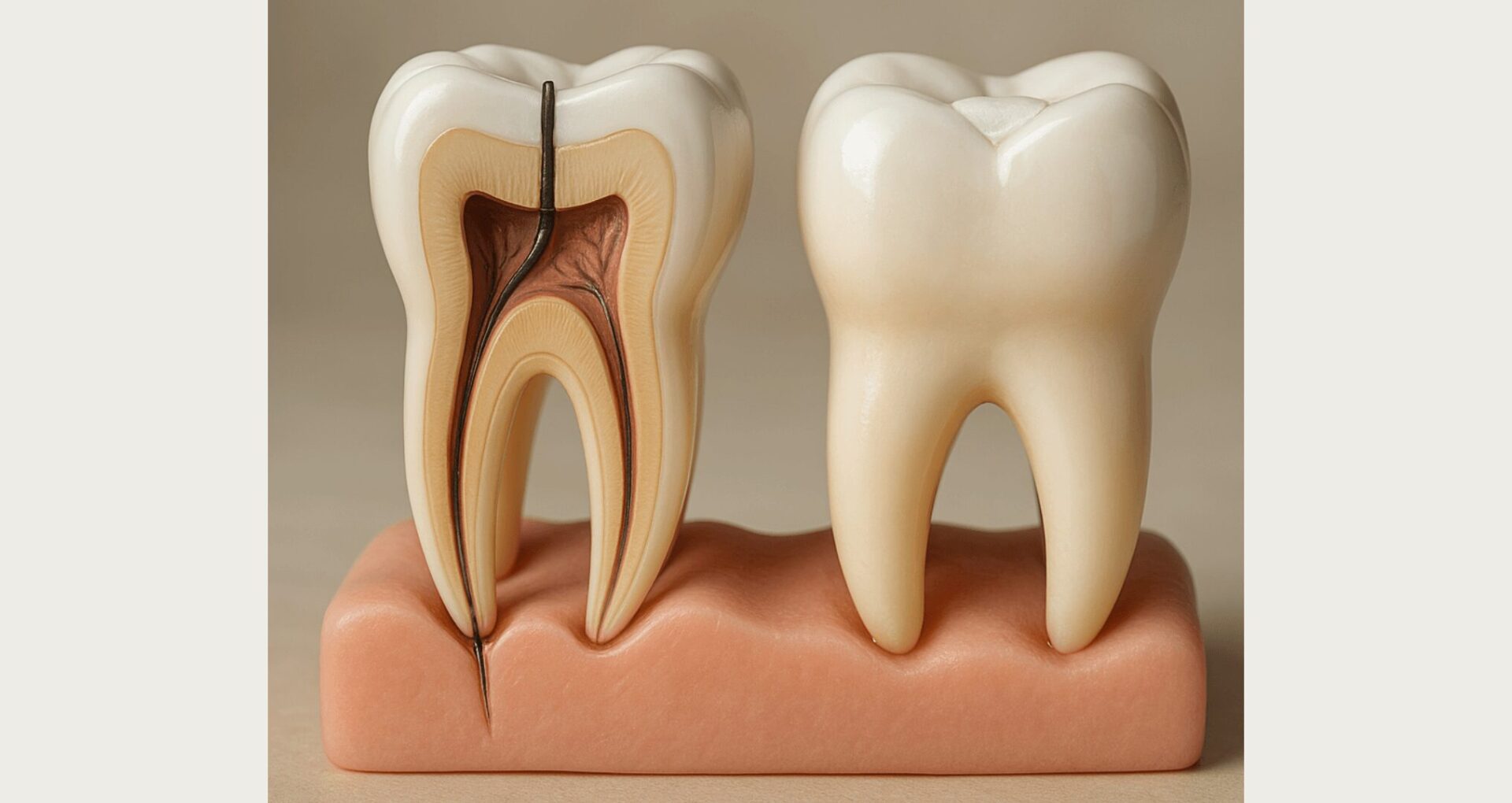
When tooth pain hits, it has a way of stopping everything in your day. Suddenly, all you’re thinking is:
“Do I need a root canal… or just a filling?”
It’s one of the most common questions we hear at Advanced Dental Care of Indiana. And we get it — nobody wants unnecessary treatment, but nobody wants pain or infection to get worse either.
The tricky part? The symptoms of a tooth that needs a filling versus one that needs a root canal can feel very similar. Add in cracked teeth, deep cavities, or broken walls, and it becomes even harder for patients to know what’s going on.
This blog breaks everything down in a simple, friendly way. By the end, you’ll understand:
- The difference between root canals and dental fillings
- When each treatment is used
- What happens if you have a cracked tooth
- Why tools like a rubber dam and ultrasonic activator matter
- What Deep Margin Elevation is — and why it may save a broken tooth
Let’s help you make sense of everything so you can protect your smile — without the confusion.
What Is a Dental Filling?
A filling is one of the simplest, most common dental treatments. It’s used when a cavity is small and only affects the outer layers of your tooth.
A filling is perfect when:
- The cavity is not too deep
- The nerve hasn’t been affected
- A small piece of the tooth chipped off
- Decay is limited to the enamel or dentin
The dentist removes the decay, cleans the area, and fills it with a tooth-colored material. You’re usually done in less than 30 minutes, and recovery is almost instant.
When a filling won’t work
A filling is not enough when:
- The cavity is deep
- The infection has reached the nerve
- Pain is lingering or throbbing
- The tooth is cracked into the pulp
- There is swelling or an abscess
This is where a root canal comes in.
What Is a Root Canal?
A root canal is a procedure that treats the inside of the tooth — the area where the nerve lives. When bacteria reach this inner space, they cause infection, inflammation, and serious pain.
A filling only treats the outside. A root canal treats the inside.
A root canal is needed when:
- The toothache is severe or throbs
- Hot/cold sensitivity lingers
- The tooth hurts to bite down
- The nerve is infected
- There’s swelling or a gum “pimple” (abscess)
- The tooth is cracked deep into the nerve
During a root canal, the dentist:
- Numbs the tooth
- Places a rubber dam to keep the tooth clean
- Removes infected nerve tissue
- Uses an ultrasonic activator to deeply clean the canals
- Fills and seals the tooth
- Places a crown later for protection
Modern root canals are gentle, predictable, and very successful at saving natural teeth.
Unsure what your tooth needs?
Get a gentle, accurate diagnosis today at a location close to you:
📍 Indianapolis: (317) 859-9444
📍 Anderson: (765) 622-7000
📍 Fortville: (317) 485-7000
📍 Cicero: (317) 984-3000
Same-day appointments available.
Why Tools Like the Rubber Dam and Ultrasonic Activation Matter
Many patients have never heard of these tools, but they are huge factors in the success of a root canal.
Rubber Dam Isolation
Think of a rubber dam as a protective sheet that exposes only the tooth being treated.
Benefits:
- Keeps saliva and bacteria out
- Prevents contamination during cleaning
- Protects your airway
- Increases success rate
- Helps you feel safer and more comfortable
Root canals should always be done with rubber dam isolation. It’s the gold standard.

Ultrasonic Activators
Inside every tooth are tiny canals that twist and turn. These spaces can’t be fully cleaned with hand tools alone.
An ultrasonic activator vibrates at high frequency to:
- Dislodge bacteria
- Break up debris
- Push disinfectant deeper
- Improve cleaning results
- Reduce chances of reinfection
This tool is one reason modern root canals feel easier and heal faster.
What Is Deep Margin Elevation (DME)?
The technique that saves teeth many dentists once had to remove
Sometimes a tooth breaks so far below the gumline that it’s nearly impossible to place a traditional filling or crown. This is especially common when a large cavity or crack destroys one or more walls of the tooth.
In the past, many of these teeth were considered hopeless and extracted.
Today, we have Deep Margin Elevation (DME).
In simple terms:
DME builds up the missing wall of a tooth to create a new, higher margin that can be restored.
Why DME matters:
- Saves teeth that would otherwise be extracted
- Makes future crowns more durable
- Works beautifully alongside root canal treatment
- Helps seal the tooth properly
- Adds strength to the remaining structure
If a tooth with a broken wall has a good root, DME may save it.
Have a cracked or deeply broken tooth?
We may still be able to save it using advanced techniques like DME.
Call your closest office:
📞 Indianapolis: (317) 859-9444 | Anderson: (765) 622-7000
📞 Fortville: (317) 485-7000 | Cicero: (317) 984-3000
| Category | Filling | Root Canal |
|---|---|---|
| Treats | Small cavities | Deep infection inside tooth |
| Pain Level | Minimal | Minimal (fully numbed) |
| Signs You Need It | Mild sensitivity, small spot of decay | Throbbing pain, swelling, cracked tooth, abscess |
| Time it takes | 20–40 minutes | 60–90 minutes |
| Longevity | 5–12 years | Often lifetime with crown |
| Cost | Lower | Higher, but saves tooth |
| When It’s Not Enough | If decay reaches nerve | Tooth has severe structural damage |
Summary:
- Fillings fix problems on the surface
- Root canals fix problems deep inside the tooth
Only a proper exam and X-ray can determine which you need.

Signs You Might Only Need a Filling
You might just need a filling if you’re experiencing:
- Mild sugar or cold sensitivity
- No lingering pain
- Small visible cavity
- Minor chip
- No swelling
Catch it early, and treatment is simple.
Signs You Likely Need a Root Canal
If you feel any of these, a root canal is more likely:
- Pain that throbs or wakes you up
- Sensitivity that lingers after hot/cold
- Pain when chewing
- Gum swelling
- Pimple-like bump on gums
- Deep crack extending toward the root
- Darkening of the tooth
A cracked tooth with nerve involvement almost always requires root canal therapy.
Don’t wait for tooth pain to worsen
Schedule an exam today — early treatment saves teeth.
📞 Indianapolis: (317) 859-9444
📞 Anderson: (765) 622-7000
📞 Fortville: (317) 485-7000
📞 Cicero: (317) 984-3000
What Happens If You Delay Treatment?
Waiting can turn a small problem into a major one.
If you delay:
- Cavities spread deeper
- Cracks travel into the root
- Infection forms an abscess
- Pain grows significantly
- The tooth may become non-restorable
- Treatment becomes more expensive
Most patients tell us they wish they hadn’t waited when they finally get relief.
What Each Procedure Is Like (Easy Step-by-Step)
Dental Filling
- Tooth is numbed
- Decay is removed
- Tooth is cleaned
- Filling is placed
- Bite is adjusted
You’re comfortable the whole time.
Root Canal
- Tooth is numbed
- Rubber dam is placed
- Infection is removed
- Ultrasonic activation thoroughly cleans canals
- Tooth is sealed inside
- A crown is placed later for full strength

Most patients say, “That wasn’t bad at all!”
Cost, Insurance & Value
Fillings are generally lower in cost, but waiting too long often turns a filling problem into a root canal + crown problem.
Insurance typically covers much of both treatments — and saving your natural tooth is almost always worth it long-term.
How We Help You Choose the Right Treatment
At Advanced Dental Care of Indiana, your comfort and clarity come first.
We provide:
- Gentle care
- Clear explanations
- Modern technology
- Flexible scheduling
- Conservative treatment approach
- A focus on saving natural teeth
We never push unnecessary treatment — we show you what’s happening and decide together.
Your Tooth Can Still Be Saved
Whether you need a filling, a root canal, or even Deep Margin Elevation, the most important thing is acting before things get worse. With the right treatment, your tooth can be saved, your pain can disappear, and your smile can stay healthy for years to come.
And remember — you’re never alone in the process.
We’re here to help, every step of the way.