

If you are searching for wisdom tooth infection symptoms, you are probably not being dramatic. Pain at the very back of the mouth, a swollen gum flap, a bad taste, jaw stiffness, or cheek swelling can be early warning signs of infection around a wisdom tooth, especially if the tooth is partially erupted or impacted. Dental experts suggest that infected or impacted wisdom teeth can cause red or swollen gums, jaw pain, bad breath, an unpleasant taste, swelling, and trouble opening the mouth.
For patients in central Indiana, this is exactly the kind of problem that should be assessed sooner rather than later. Advanced Dental Care of Indiana has offices in Indianapolis, Anderson, Fortville, and Cicero, and the practice offers emergency dentistry, tooth extraction, root canal treatment, crowns and restorative dental care.
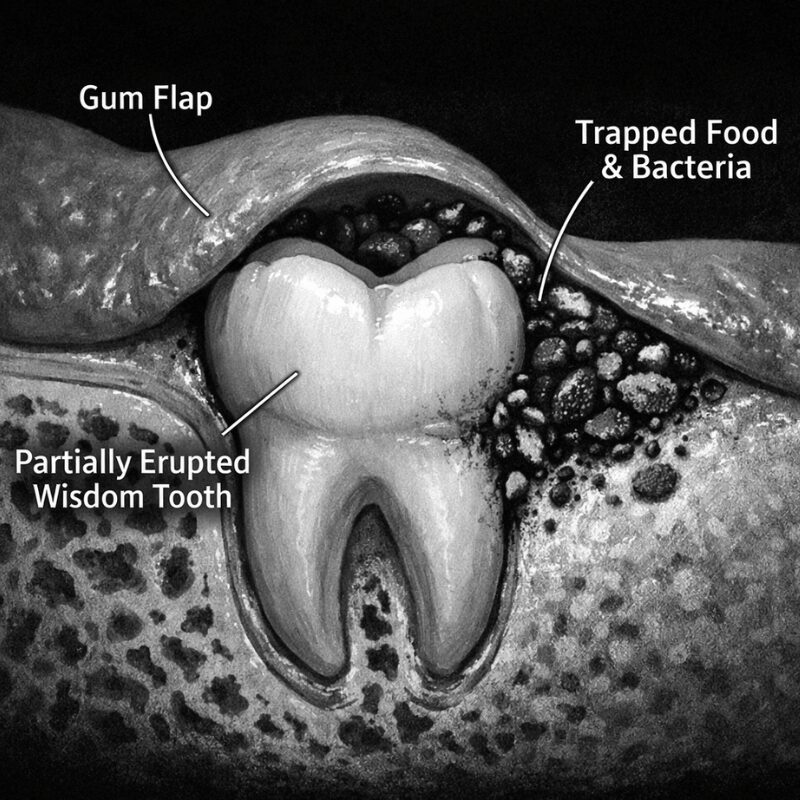
The most common causes of wisdom tooth infection are pericoronitis and impaction. Pericoronitis happens when a wisdom tooth partly breaks through the gum, leaving a small flap of tissue that traps food and bacteria. If bacteria build up deeper in the tissues or the nerve space of a tooth, an abscess can form. These infections often start with soreness, swelling and difficulty chewing, but they can spread into the face, jaw and neck if treatment is delayed.
The symptoms patients should not ignore are worsening pain, a bad taste or bad smell in the mouth, visible gum or cheek swelling, fever, swollen glands, limited mouth opening, and any swelling that seems to be spreading. If you have difficulty breathing, swallowing or speaking, or swelling around the eye or deep into the neck, emergency medical care is appropriate. Short-term home care can reduce discomfort, but it does not remove the cause; definitive dental treatment may include cleaning and irrigation, incision and drainage, extraction, antibiotics when systemic spread is suspected, or restorative treatment if a saveable tooth is involved.
Why wisdom teeth get infected
Wisdom teeth, the final set of molars, frequently lack sufficient space for a clean eruption. According to the American Dental Association (ADA), when these teeth only partially emerge, bacteria can invade the gums and cause an infection. This often results in pain, swelling, and stiffness in the jaw. Similarly, the Mayo Clinic points out that impacted wisdom teeth are susceptible to infection, which can lead to swelling and difficulty opening the mouth.
The first major cause is pericoronitis. This is an infection and inflammation of the soft tissue surrounding a partially erupted tooth, most often a lower wisdom tooth. The small space under the gum flap is difficult to clean, so food and bacteria collect there easily, which makes it an ideal environment for infection.
The second major cause is an impacted wisdom tooth. An impacted tooth is trapped under gum tissue or bone or angled in a way that prevents normal eruption. The National Health Service (NHS) in United Kingdom notes that impacted or partly covered wisdom teeth can lead to pain and swelling, pericoronitis, food trapping, tooth decay, gum disease, cysts and even a dental abscess.
The third cause is a true abscess, meaning pus has collected because of bacterial infection. Mayo Clinic explains that an abscess can cause severe throbbing pain, swelling, fever, tender neck glands, foul odour and a foul-tasting discharge if it drains. The NHS also notes that an impacted tooth can be one cause of a dental abscess.
Symptoms to take seriously
Many patients search, “infected wisdom tooth what does it feel like?” The honest answer is that it often does not feel like a classic cavity at first. It may start as tenderness behind the last molar, soreness when chewing, or a swollen gum flap that keeps getting caught by the upper tooth. As inflammation worsens, symptoms may include gum redness, bleeding, jaw pain, bad breath, a bad taste, swelling around the jaw, and limited mouth opening.
Less-common but important symptoms include swollen glands in the neck, fever, pain that radiates towards the ear or neck, pus or foul-tasting fluid, and a sudden burst of salty fluid followed by temporary pain relief if an abscess ruptures. Those features suggest the infection is becoming more significant, not resolving.
| Symptom Pattern | Likely Concern | Urgency |
|---|---|---|
| Mild soreness at the back of the mouth, swollen gum flap, food trapping, no fever | Early pericoronitis or irritation around a partially erupted wisdom tooth | Mild – book a dental visit soon |
| Ongoing pain, bad taste, bad breath, tenderness when chewing, visible gum swelling | Active local infection that is unlikely to settle permanently without treatment | Moderate – urgent dental call within 24 hours |
| Cheek or jaw swelling, fever, swollen glands, limited mouth opening, painful swallowing | Infection may be spreading beyond the gum flap | High urgency – same-day dental assessment |
| Spreading facial or neck swelling, trouble breathing, swallowing or speaking, eye swelling, severe trismus | Possible deep-space infection or airway risk | Emergency – go to the Dentist immediately |
This practical urgency guide is based on Mayo Clinic and NHS emergency advice together with peer-reviewed reviews of severe odontogenic infection.
If your symptoms sound more than “mild”, call for an exam rather than hoping it settles. Advanced Dental Care of Indiana can evaluate urgent dental pain in Indianapolis (317) 926-5200, Anderson (765) 622-7000, Fortville (317) 485-7000, or Cicero (317) 984-3000. The practice lists emergency dentistry, tooth extraction, root canal treatment and restorative services across its offices.
When swelling becomes an emergency
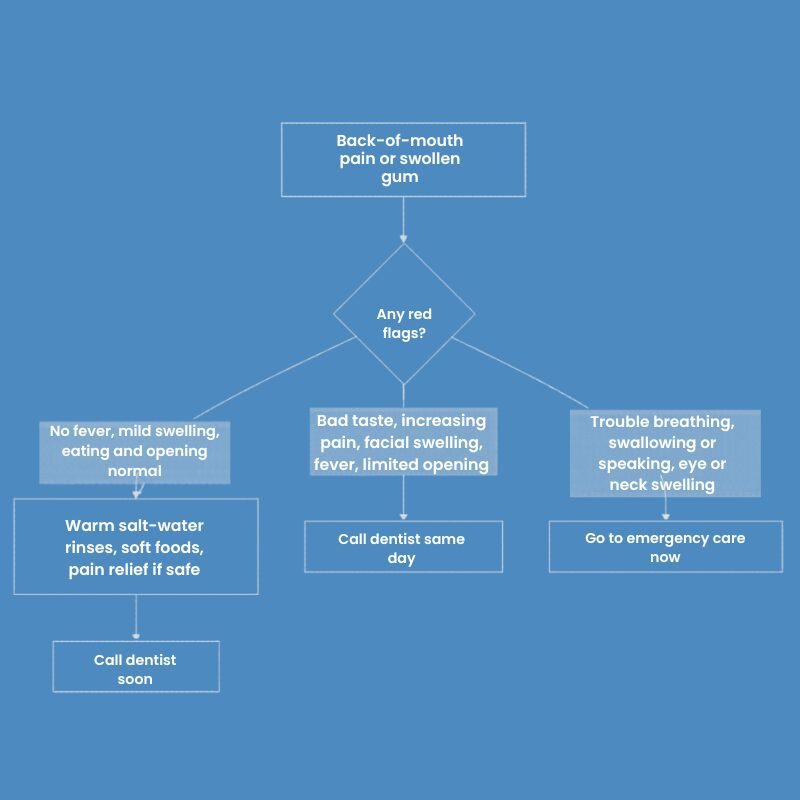
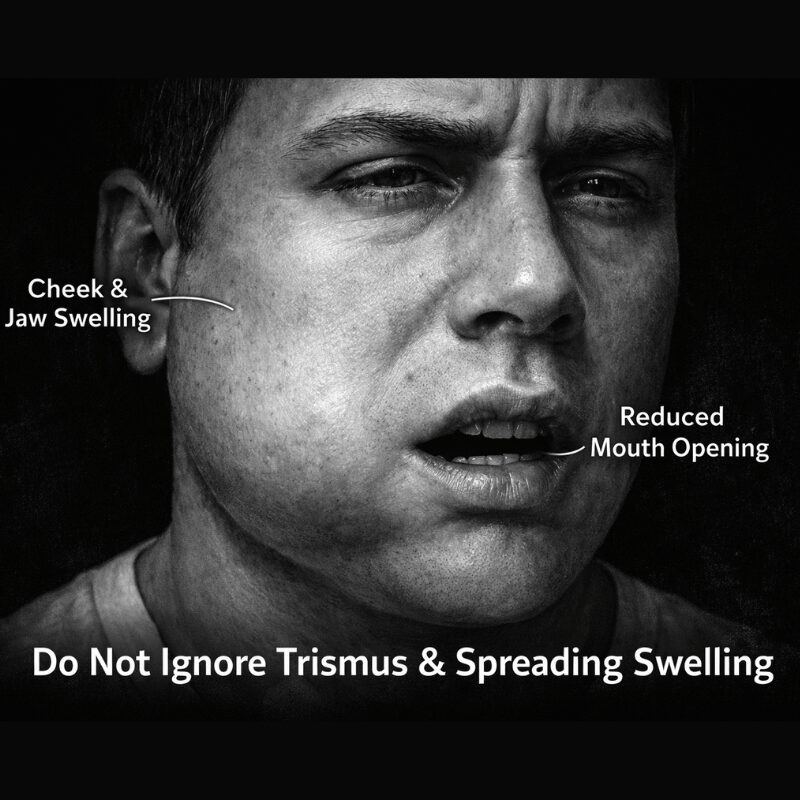
If you are wondering whether wisdom tooth swelling constitutes an emergency, the answer is that it can, sometimes. Swelling is considered an emergency if it is spreading, restricts how wide you can open your mouth, or begins to interfere with your airway or swallowing.
Dental professionals recommend seeking emergency care if you have facial swelling and cannot see a dentist, or if you experience difficulty breathing or swallowing. Similar guidance is offered by the NHS, which also highlights that swelling around the eye, neck swelling, or severe difficulty opening the mouth are all reasons for heightened concern.
Peer-reviewed reviews describe the classic red flags of severe odontogenic infection as trismus, pain, swelling, dysphagia, dysphonia and fever. In other words, when a wisdom tooth infection starts changing the way you open your mouth, swallow, speak or breathe, it has moved beyond “routine dental pain”.
What to do before you are seen
Evidence-based short-term home care is about comfort and cleanliness, not cure. Mayo Clinic recommends rinsing with warm water, gently flossing out trapped debris if possible, using appropriate non-prescription pain relief, and placing a cold compress on the outside of the cheek if needed; it also warns not to place aspirin directly on the gums. The NHS recommends paracetamol or ibuprofen if suitable for you, salt-water rinses, soft foods, and avoiding very hot, cold or sweet foods.
A sensible short-term plan is to rinse gently with warm salt water, eat on the other side, choose softer foods, keep the area as clean as you comfortably can, and use pain relief only as directed on the label or by your clinician. Do not smoke, do not keep “testing” the sore tooth, and do not rely on left-over antibiotics or mouth gels to solve the problem. Persistent pain, bad taste, swelling or fever still needs professional care.
How dentists usually treat it
Treatment depends on what is actually infected. In mild pericoronitis, first-line care is often local irrigation and debridement to flush out trapped debris and lower the bacterial load. StatPearls describes this as the recommended starting point for mildly symptomatic cases with low concern for systemic spread, and notes that oral hygiene support is part of treatment and prevention.
If the infection has become more significant, your dentist may recommend incision and drainage if an abscess is present. Mayo Clinic states that the goal is to get rid of the infection by draining pus, performing root canal treatment to save a tooth where appropriate, or extracting a tooth that cannot be saved. It also notes that antibiotics may be needed when infection has spread, but not every localised abscess requires them. The ADA makes the same broader point: definitive dental treatment should come first, while antibiotics are mainly indicated when systemic involvement is present.
For poorly positioned or repeatedly infected wisdom teeth, extraction is often the most reliable long-term fix. Extraction is the most permanent solution when the tooth is unfavourably positioned, because the infected space cannot be cleaned well enough for the problem to stop recurring. The NHS and ADA also list infection, pain, gum disease, abscess and damage to neighbouring teeth as common reasons wisdom teeth are removed.
Not every painful back-tooth problem ends with extraction, though. Sometimes the wisdom tooth has contributed to decay or damage in the tooth next to it, or the main infection is in a tooth that can be saved. Mayo Clinic notes that root canal therapy can eliminate infection and preserve a tooth, often followed by a crown for strength, and Advanced Dental Care of Indiana offers both root canal treatment and crowns as part of its restorative care.

Need a wisdom tooth dentist in Indianapolis or nearby?
Advanced Dental Care of Indiana can assess whether you need cleaning under the gum flap, drainage, extraction, or a restorative plan for a saveable tooth. Call Indianapolis (317) 926-5200, Anderson (765) 622-7000, Fortville (317) 485-7000, or Cicero (317) 984-3000 to arrange an urgent evaluation.
How to lower your risk
You cannot always control how wisdom teeth erupt, but you can reduce the odds of infection getting established. Good brushing and flossing, cleaning around erupting molars, regular check-ups and x-rays when advised all help dentists spot food traps, gum inflammation, decay and unfavourable impaction before they become emergencies. The ADA emphasizes the need for continuous monitoring of wisdom teeth that are not extracted, whereas the NHS advises routine dental check-ups to ensure the early detection of any emerging issues.
Frequently Asked Questions
About Wisdom Tooth Infection
No. If the tooth erupts fully, is functional, and stays disease-free, it may simply be monitored. But if it is repeatedly infected, badly positioned, damaging a neighbouring tooth, or impossible to keep clean, extraction is often the most predictable long-term solution.
Go for emergency care if you have trouble breathing, swallowing or speaking, swelling into the neck or around the eye, or severe difficulty opening your mouth. Those are the red flags most associated with serious spreading infection.
Usually not. ADA guidance says dentists should prioritise definitive dental treatment, and antibiotics are mainly for cases with systemic involvement or spreading infection. If pus, calculus, decay, or an impacted tooth remains, symptoms often return.
A mild flare can seem to calm down, but the underlying food trap or impaction often remains. NHS guidance on dental abscesses is very clear that an abscess will not go away on its own, and recurrent pericoronitis is common when the area remains hard to clean.
Usually it feels like soreness or pressure behind the last molar that becomes more inflamed over time. Common clues are swollen or bleeding gums, jaw pain, a bad taste, bad breath, pain when chewing and difficulty opening your mouth.