
Your dentist mentioned a crown. Or maybe a bridge. Possibly both, in the same sentence.
And now you’re at home trying to work out what the difference actually is, what each one costs, and whether you’re about to be talked into something you don’t need.
That’s a fair place to be. The dental crown vs bridge question sounds complicated, but the answer usually comes down to one simple thing: is the tooth still in your mouth?
In this guide we’ll explain what each one does, the trade-off with bridges that most people never hear about, honest cost ranges, how long each lasts, and how to tell which one fits your situation.
The One Question That Decides It
Here’s the shortcut.
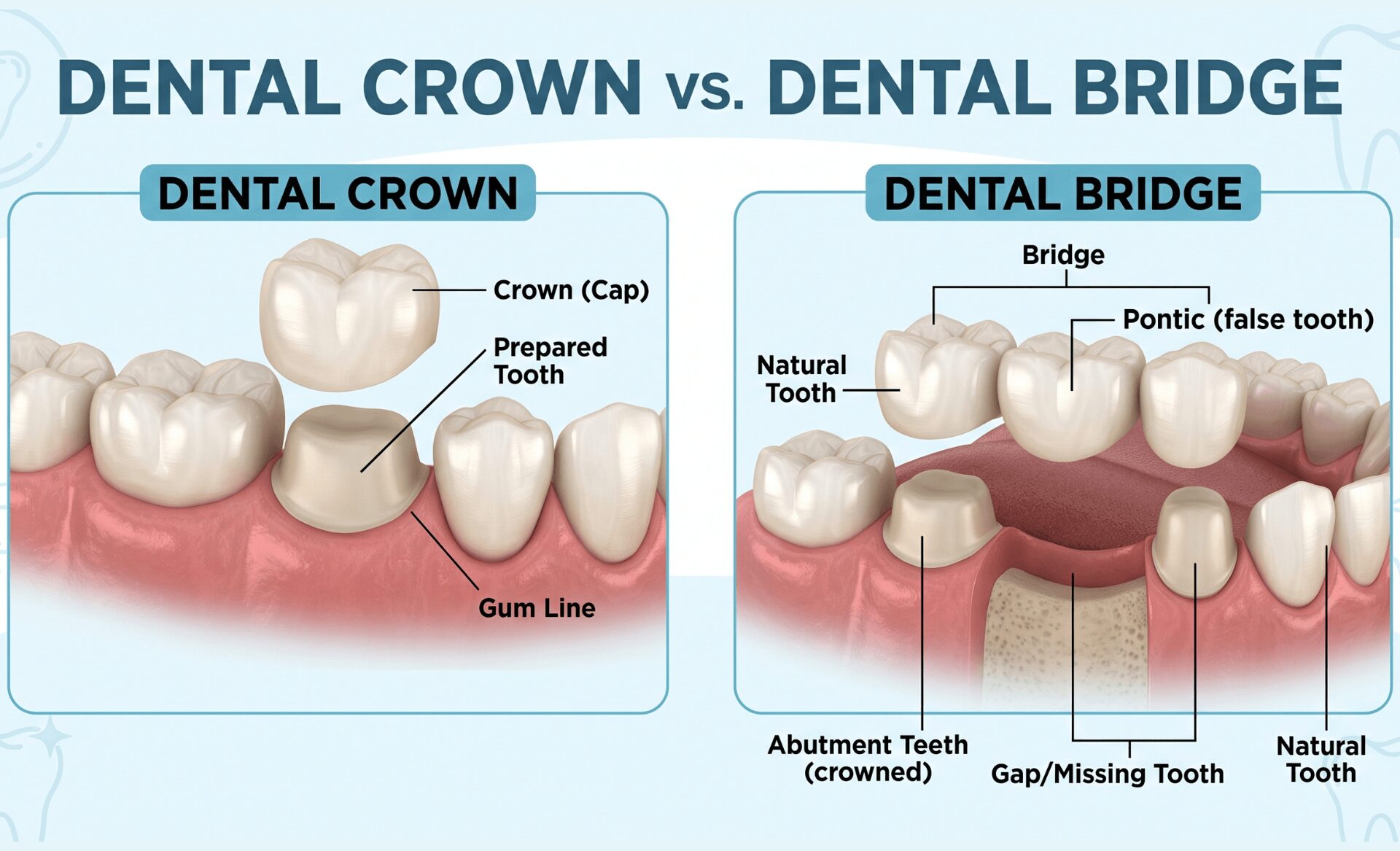
A crown covers a tooth you still have. It’s a cap that goes over a damaged, cracked, or heavily filled tooth to protect what’s left and restore its shape.
A bridge replaces a tooth you’ve lost. It fills the gap using the teeth on either side as support.
That’s the core of it. Crown equals repair. Bridge equals replace.
So if you’re wondering which one you need, start there. Is there still a tooth to save, or is there a gap?
Everything else — materials, cost, how long it lasts — comes after that.
What Is a Dental Crown?
Think of a crown as a helmet for a tooth.
Your dentist reshapes the damaged tooth slightly, takes an impression, and fits a custom cap over it. The crown takes on the chewing force so the weakened tooth underneath doesn’t crack further.
When You’d Need One
A crown is usually the answer when a tooth is damaged but still has healthy root structure. Common reasons include:
A large filling that’s now bigger than the remaining tooth. A cracked or fractured tooth. A tooth that’s been through root canal treatment — especially a molar, which takes heavy chewing pressure. Or a badly worn or discoloured front tooth where appearance matters.

Crowns come in several materials. Porcelain crowns and all-ceramic look the most natural, which is why they’re often chosen for a front tooth crown. Zirconia and gold are stronger and tend to go on back teeth. Your dentist will talk you through which material suits your tooth — it depends on where the tooth sits and how hard you grind.
What Is a Dental Bridge?
A bridge does what the name suggests. It spans a gap.
A traditional bridge is made of three connected pieces: a crown on the tooth to the left, a false tooth in the middle, and a crown on the tooth to the right. It’s cemented in permanently, so you don’t take it out.
That middle tooth is called a pontic. It sits on your gum and fills the space, which keeps your bite even and stops the surrounding teeth from drifting into the gap.
For front teeth, there’s a lighter option called a Maryland bridge. It uses small wings bonded to the back of the neighbouring teeth instead of full crowns, so much less healthy tooth gets removed. It’s less strong, which is why it’s generally used for a dental bridge front teeth situation rather than molars.
The Trade-Off Nobody Mentions
Here’s the part you deserve to hear before you agree to anything.
To place a traditional bridge, your dentist has to file down the two healthy teeth either side of the gap. They have to be reduced to fit crowns. That’s permanent — those teeth can never go back to how they were.
If those neighbouring teeth already need crowns anyway, that’s not really a loss. A bridge might be an excellent choice.
But if they’re perfectly healthy, it’s worth asking your dentist whether a dental implant would leave more of your natural teeth intact. It costs more up front and takes longer, but it doesn’t touch the teeth beside it.
A good dentist will raise this with you unprompted. If nobody has, ask.
🦷 Not sure whether your tooth can still be saved?
That’s exactly what an exam is for. Our teams in Indianapolis, Fortville, Anderson, and Cicero will tell you honestly whether a crown will do the job — or whether you’re past that point. Book an exam →
Dental Crown vs Bridge: Side by Side
| Dental Crown | Dental Bridge | |
|---|---|---|
| What it’s for | A tooth that’s damaged but still there | A tooth that’s missing |
| Teeth involved | Just the one | The gap plus the two teeth beside it |
| Healthy teeth affected | None | Two get filed down (traditional bridge) |
| Typical visits | 2 | 2 to 3 |
| Typical lifespan | 10 to 20 years | 10 to 15 years |
| Removable | No | No |
What Do Crowns and Bridges Cost in Indiana?
Let’s talk numbers, because this is usually the real question.
Crowns. As of 2026, a single crown typically runs $800 to $3,000 depending on the material. Porcelain-fused-to-metal sits at the lower end. All-ceramic, zirconia and E-max sit higher. The national average lands around $1,369.
Bridges. A traditional three-unit bridge — that’s the false tooth plus two anchor crowns — typically runs $2,000 to $5,000, averaging around $3,500. A Maryland bridge for a front tooth is usually less, around $1,500 to $2,500.
A bridge costs more than a crown because you’re paying for three units of work, not one.
On insurance. Most plans treat both as major restorative work and cover around 50% after your deductible. Two things catch people out. First, your annual maximum — often $1,000 to $2,000 — can get used up fast on a bridge. Second, some policies have a missing tooth clause that won’t cover replacing a tooth you lost before the policy started.
We’d rather you knew that before treatment than after. Our front desk can check your benefits and give you a written estimate first — just ask when you book.
What About Front Teeth?
Front teeth change the conversation, because appearance matters more and chewing force matters less.
For a damaged front tooth, an all-ceramic or porcelain crown usually gives the most natural result. Light passes through it in a similar way to natural enamel, so it doesn’t look flat or grey at the gumline.
For a missing front tooth, a Maryland bridge is often worth discussing because it preserves far more of the neighbouring teeth. It won’t suit everyone — it depends on your bite — but it should be on the table.
If you’ve been searching for before-and-after photos of a teeth bridge to see what results look like, bring those to your appointment. It genuinely helps us understand what you’re hoping for.
How Long Do Crowns and Bridges Last?
With good care, a crown commonly lasts 10 to 20 years, and gold crowns can go longer. A traditional bridge commonly lasts 10 to 15 years, and plenty last longer than that.
Here’s the useful detail: bridges rarely fail because the bridge itself breaks. They usually fail because decay develops in one of the anchor teeth underneath.
That’s good news, because it’s largely preventable. It means flossing under the bridge with a floss threader or water flosser genuinely matters, and so does keeping up with regular cleanings.
When to See a Dentist

Don’t wait it out if you notice any of these:
A cracked or broken tooth, even without pain. A large old filling that feels loose or sharp. Sensitivity when you bite down on one specific tooth. A crown that’s come off. A gap where a tooth used to be, especially if nearby teeth are starting to tilt.
That last one matters more than people realise. When a tooth is missing, the teeth around it gradually drift, and your bite changes. What could have been a straightforward bridge can turn into a much bigger job if it’s left for years.
🦷 Get a straight answer about your tooth.
Crown, bridge, or neither — we’ll show you what’s going on, explain your options in plain English, and give you honest pricing before you commit to anything. Schedule your consultation →
Frequently Asked Questions
Use a floss threader or a water flosser daily to clean underneath the false tooth. Decay in the supporting teeth is the most common reason bridges eventually need replacing, so this step really does extend its life.
A traditional bridge requires filing down both neighbouring teeth so crowns can fit over them, and that’s permanent. A Maryland bridge removes far less. This is worth discussing with your dentist before you decide.
A crown typically runs $800 to $2,500. A traditional three-unit bridge typically runs $2,000 to $5,000, because it’s three pieces of work rather than one.
They’re not competing options — they solve different problems. If your tooth is still there and can be saved, you need a crown. If it’s missing, a crown isn’t possible.
A crown covers and protects a tooth you still have. A bridge replaces a tooth that’s already gone, using the neighbouring teeth to hold it in place.
The Bottom Line
The dental crown vs bridge decision is far simpler than it sounds.
If your tooth is damaged but still there, a crown protects what you’ve got. If the tooth is gone, a bridge fills the gap — but it does mean reshaping the two healthy teeth beside it, so it’s worth asking about implants too before you decide.
What matters most is not leaving it. Cracked teeth get worse, and gaps let the surrounding teeth drift. Both problems are easier and cheaper to fix early.
🦷 Don’t let a small problem turn into a big one.
A cracked tooth or an empty gap won’t fix itself — but both are very treatable right now. Our teams in Indianapolis, Fortville, Anderson and Cicero will give you honest advice and clear costs, with no pressure. Contact the office nearest you →