

You brush every day. You floss (most days). So why does your dentist still find buildup at your checkup?
The answer usually comes down to two things: plaque and tartar. Most people have heard both words, but they’re not the same — and confusing them can mean you’re missing a step in your oral care routine.
In this guide, we’ll break down exactly what plaque and tartar are, how one leads to the other, and what you can actually do to get rid of both.
What Is Plaque on Teeth?
Plaque is a soft, sticky film that forms on your teeth throughout the day. It’s made up of bacteria, saliva, and tiny food particles — and it starts forming within minutes of eating or drinking.
You can’t always see it, but you’ve probably felt it. That fuzzy or “coated” feeling on your teeth after a long day? That’s plaque.
Here’s why it matters: the bacteria in plaque feed on sugars and starches from your food. As they do, they release acids that slowly erode your tooth enamel. Left unchecked, that leads to cavities — and eventually, gum disease.
What Is Tartar on Teeth?
Tartar — also called calculus on teeth — is what happens when plaque isn’t removed in time.
When plaque sits on your teeth for 24 to 72 hours, it absorbs minerals from your saliva and begins to harden. Once it hardens into tartar, you can no longer brush or floss it away. It bonds tightly to your enamel and can only be safely removed with professional dental tools.
Tartar is visible. It typically appears as a yellow, brown, or even dark deposit along your gumline or behind your lower front teeth. It feels rough and crusty when you run your tongue over it.
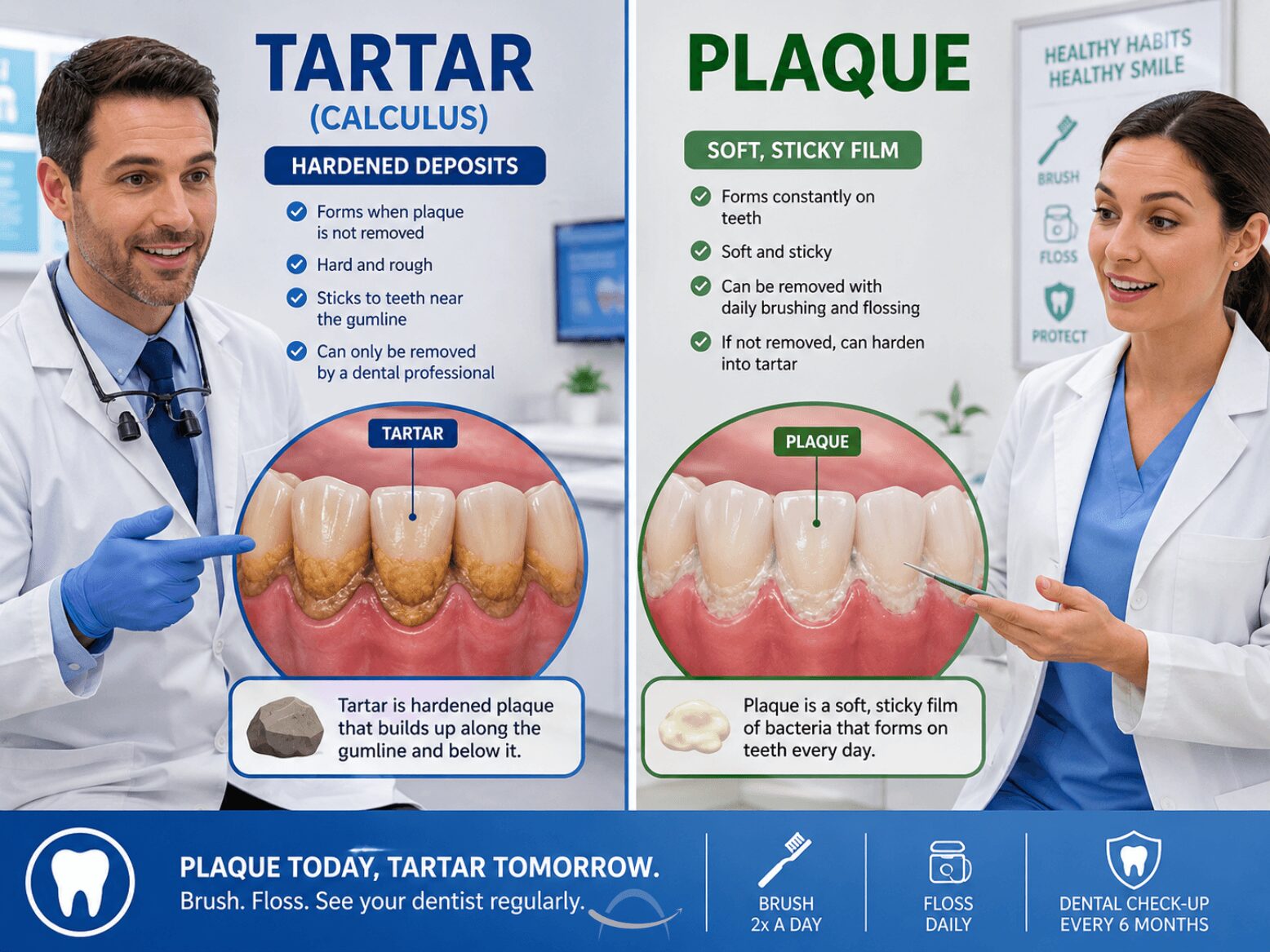
It can form above the gumline, where you can see it, or below the gumline, where it silently damages the surrounding bone and tissue.
The simple version: Plaque is Stage 1 — soft, invisible, and removable at home. Tartar is Stage 2 — hard, visible, and requires a dentist to remove.
Plaque vs. Tartar: Key Differences at a Glance
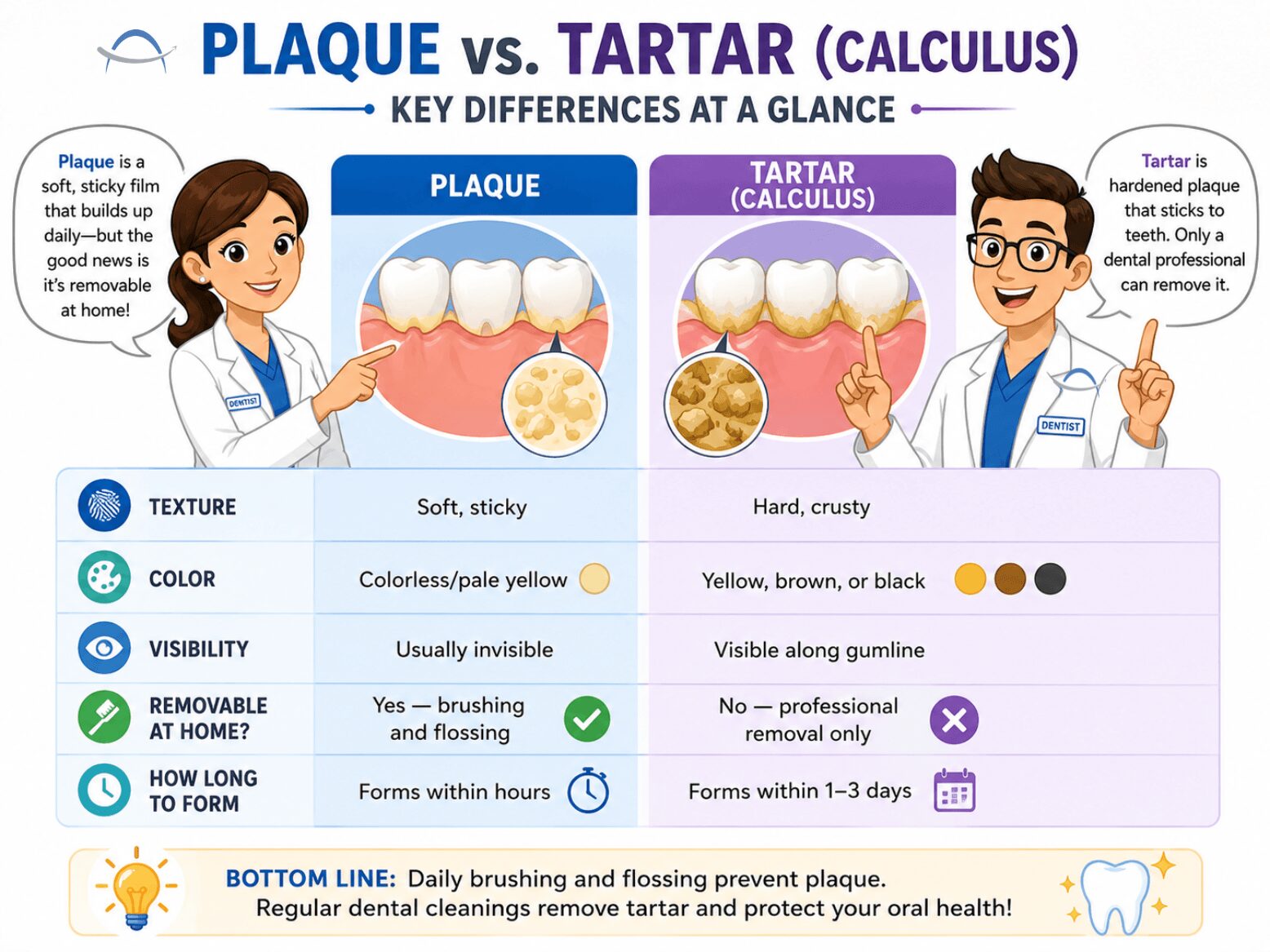
| Plaque | Tartar | |
|---|---|---|
| Texture | Soft, sticky | Hard, crusty |
| Color | Colorless/pale yellow | Yellow, brown, or black |
| Visibility | Usually invisible | Visible along gumline |
| Removable at home? | Yes — brushing and flossing | No — professional removal only |
| How long to form | Forms within hours | Forms within 1–3 days |
What Causes Plaque and Tartar to Build Up Faster?
Some people seem to battle plaque and tartar more than others. Several factors speed up buildup:
- Sugary or starchy diet — bacteria thrive on these
- Skipping brushing sessions — even one missed night makes a difference
- Dry mouth — saliva helps neutralize acids; less saliva means more buildup
- Smoking or tobacco use — significantly accelerates tartar formation
- Crooked or crowded teeth — harder to clean all surfaces properly
- Genetics — some people’s saliva composition makes them more prone to calculus
If you notice faster-than-usual buildup, it’s worth mentioning to your dental team. They can recommend a personalized cleaning schedule.
Symptoms: How Do You Know If You Have Tartar Buildup?
Plaque usually has no visible signs — which is why a consistent routine matters. Tartar, on the other hand, often shows warning signs:
- Yellow, brown, or black staining along the gumline
- Bad breath that doesn’t improve with brushing
- Red, swollen, or bleeding gums (early signs of gingivitis)
- A rough or bumpy feeling on teeth surfaces
- Visible dark crust, especially behind lower front teeth
If you’re noticing any of these, it’s time to get a professional cleaning. Tartar that’s left in place will continue to irritate your gums and can progress to gum disease and bone loss over time.
Ready to get your teeth professionally cleaned?
The team at Advanced Dental Care of Indiana serves families across Anderson, Fortville, and Indianapolis. Our hygienists use professional tools to safely clear both plaque and tartar — quickly and comfortably.
Schedule a professional cleaning today →
How to Remove Plaque from Teeth at Home
The most effective way to control plaque is through daily habits — done correctly.
Brush twice a day, for two full minutes. Use a soft-bristled toothbrush and fluoride toothpaste. Make sure you’re reaching all surfaces — front, back, and the chewing surfaces of every tooth.
Floss once daily. Flossing removes plaque from between teeth and below the gumline — places your toothbrush simply can’t reach.
Use an antibacterial mouthwash. This helps kill bacteria that cause plaque and freshens breath at the same time.

Limit sugary and starchy foods. You don’t have to cut them out entirely, but reducing how often you snack on them gives bacteria less to feed on.
Drink more water. Especially fluoridated tap water. It rinses away food particles and supports saliva production.
These habits won’t remove existing tartar, but they’re extremely effective at preventing new plaque from hardening in the first place.
How to Remove Tartar on Teeth (Hint: You Can’t Do This One Alone)
Here’s the truth: there is no safe way to remove tartar at home.
You may have seen TikTok videos or products promising to scrape tartar off at home. Dental professionals strongly advise against this. Using sharp tools on your own teeth without proper training can scratch enamel, damage gum tissue, and actually make the problem worse.
The only safe, effective way to remove tartar is through a professional dental cleaning performed by a licensed dental hygienist or dentist.
During a cleaning, your hygienist uses a process called scaling — using specialized instruments to carefully break up and remove tartar deposits from above and below the gumline. The procedure is straightforward, and for most patients, it’s completely comfortable.
If tartar has built up significantly below the gumline, a deeper treatment called scaling and root planing (sometimes called a “deep cleaning”) may be recommended. This targets deeper deposits and helps the gums reattach to the teeth.
At Advanced Dental Care of Indiana, our hygienists make the process as smooth as possible — even for patients who feel nervous about the dentist. If dental anxiety is a concern for you, ask us about our comfort dentistry options.
When Should You See a Dentist About Plaque or Tartar?
Most adults should schedule a professional dental cleaning every six months. Some patients — especially those prone to tartar buildup, gum disease, or dry mouth — may benefit from cleanings every three to four months.
You should make an appointment sooner if you notice:
- Visible dark deposits on your teeth
- Gums that bleed when you brush or floss
- Persistent bad breath despite regular brushing
- Tooth sensitivity that’s getting worse
- Gums that look like they’re pulling away from teeth
These are signs that buildup has already started affecting your gum health. The earlier it’s treated, the simpler the solution.
🦷 Don’t let tartar work against you any longer.
Our team at Advanced Dental Care of Indiana has locations in Anderson, Fortville, and Indianapolis — making it easy to find a convenient time that works for your schedule.
Book your cleaning appointment now →
Prevention Tips: Staying Ahead of Both Plaque and Tartar

Prevention is always easier than treatment. Here’s how to keep both plaque and tartar in check long-term:
- Brush for two minutes, twice a day — most people brush for less than 45 seconds
- Floss every single day — not just when something is stuck
- Use tartar-control toothpaste — contains ingredients that help slow mineral buildup
- Stay hydrated — dry mouth accelerates plaque
- Quit smoking — tobacco is one of the biggest contributors to fast tartar buildup
- Keep your six-month cleaning appointments — even when your teeth feel fine
The combination of a solid home routine and regular professional cleanings is genuinely the most effective approach. No product or gadget replaces either one.
Frequently Asked Questions
For most patients, a routine cleaning is comfortable with little to no discomfort. If you have sensitive gums or significant tartar buildup, there may be mild tenderness — but the process is quick. If you’re worried, let your hygienist know. They can adjust their technique or recommend a comfort option.
Most people should have a professional cleaning every six months. If you’re prone to faster tartar buildup, have gum disease, or dry mouth, your dentist may recommend every three to four months.
Tartar typically appears as yellow or brown crusty deposits along the gumline, most commonly behind the lower front teeth. In more advanced cases, it can appear dark brown or even black.
Yes. Tartar buildup creates small pockets between teeth and gums where bacteria and food debris get trapped, leading to persistent bad breath that doesn’t improve with brushing alone.
Plaque can begin hardening into tartar in as little as 24 to 72 hours if it isn’t removed by brushing and flossing. This is why consistent daily oral hygiene matters so much.
No — and attempting to do so with sharp objects can seriously damage your enamel and gums. Tartar requires professional removal using specialized dental instruments. Only a licensed hygienist or dentist can do this safely.
The Bottom Line
Plaque and tartar are closely related — but they’re not the same, and they require different approaches.
Plaque you can control at home with a solid brushing and flossing routine. Tartar has already hardened and needs professional removal before it damages your gums or leads to bigger problems.
The best strategy is simple: stay consistent with your home care, and don’t skip your regular cleanings. Those twice-yearly appointments aren’t just about having clean teeth — they’re what keeps small buildup from becoming a real problem.
📞 Time for a fresh start?
Whether it’s been six months or a few years since your last cleaning, the team at Advanced Dental Care of Indiana is here without judgment — just professional care focused on your long-term health.
Serving families in Anderson, Fortville, and Indianapolis, Indiana.
Schedule your professional cleaning today → Or call us directly: (765) 622-7000 (Anderson) | (317) 485-7000 (Fortville) | (317) 926-5200 (Indianapolis) | (317) 984-3000 (Cicero)
Advanced Dental Care of Indiana — Comprehensive family dentistry for Indiana families, with a focus on comfort, modern care, and lasting results.